

Practice tests for this exam: ServiceNow CSA Practice Tests 2026 | Zurich & Australia on Udemy. 6 timed tests of 60 questions, with every option explained and a documentation link for each question.
The ServiceNow CSA exam (Certified System Administrator) is where most people start their ServiceNow certifications. It has 60 questions in 90 minutes, and Database Management and Platform Security alone is 30% of it. Below are the exam facts, the January 2026 blueprint, the topics that deserve the most time, a 4-week plan, the documentation to bookmark and five original sample questions with explanations.
Every later ServiceNow exam assumes you already know how tables relate, how access control decides who sees what, how data gets imported and how configuration moves between instances. In eight years of ServiceNow projects, most of the “strange platform behavior” I have been asked to explain came down to one of those basics.
Key facts
- Format: 60 questions in 90 minutes. Multiple choice and multiple select, with no partial credit on multiple select.
- Blueprint: KB0011554, updated January 2026. Database Management and Platform Security 30%. Platform Overview and Navigation 7%.
- Where it fits: the entry point of the path, before CIS-Data Foundations, CIS-ITSM, CAD and CIS-CSM.
- Delivery: Pearson VUE, at a test center or online (OnVUE). You register through ServiceNow University and have 90 days to complete the exam.
- Passing score: not published by ServiceNow.
CSA exam facts
| Item | Detail |
|---|---|
| Exam | Certified System Administrator (CSA), mainline exam |
| Blueprint | KB0011554, updated January 2026 |
| Number of questions | 60 |
| Duration | 90 minutes |
| Question types | Multiple choice (single answer) and multiple select (the question tells you how many to choose) |
| Partial credit | Not given on multiple select questions |
| Passing score | Not published by ServiceNow |
| Delivery | Proctored through Pearson VUE, at a test center or online (OnVUE), registered through ServiceNow University |
| Scheduling window | 90 days from registration to complete the exam |
The blueprint sits on ServiceNow University and asks you to sign in. Confirm the details in the current version before you book.
ServiceNow CSA exam blueprint: January 2026 weights
| Domain | Weight |
|---|---|
| Database Management and Platform Security | 30% |
| Configuring Applications for Collaboration | 20% |
| Self Service & Automation | 20% |
| Data Migration and Integration | 13% |
| Instance Configuration | 10% |
| Platform Overview and Navigation | 7% |
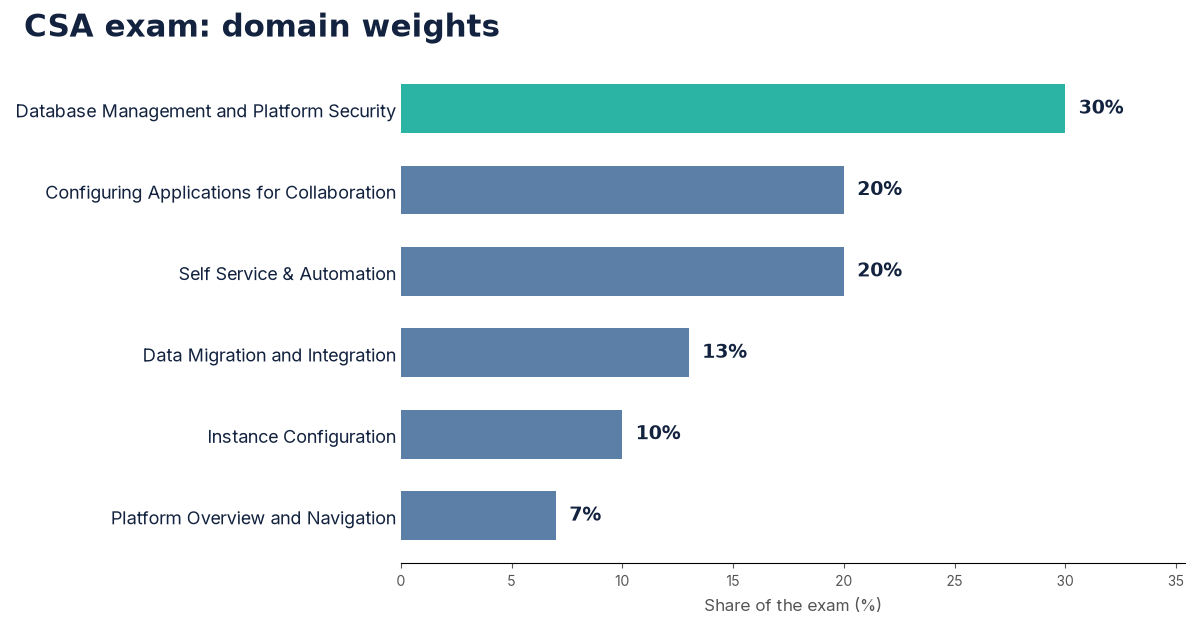
Source: Certified System Administrator (CSA) Mainline Exam Blueprint, KB0011554 (ServiceNow University, sign-in required).
Two things stand out. Database Management and Platform Security is almost a third of the exam, so data schema, access control and importing data deserve the most time. And Platform Overview and Navigation is only 7%: if your preparation has mostly been clicking around the interface, you have covered the smallest domain.
What each CSA domain covers
Platform Overview and Navigation (7%)
- What the platform and an instance are, and the main platform capabilities.
- Next Experience Unified Navigation: the All menu, Favorites and History.
Instance Configuration (10%)
- Installing applications and plugins.
- Personalizing versus configuring the instance, and the common user interfaces.
Configuring Applications for Collaboration (20%)
- Lists, filters and tags; list and form anatomy; form configuration and templates.
- Task management and Visual Task Boards.
- Dashboards, Platform Analytics and notifications. For a notification, know the difference between “When to send” and “Who will receive”.
Self Service & Automation (20%)
- Knowledge Management and Service Catalog basics.
- Workflow Studio. A flow is a trigger plus actions, and flows run in the background.
- Virtual Agent.
Database Management and Platform Security (30%)
- Data schema: tables, fields, reference fields and table extension. A table that extends Task inherits Task’s fields.
- Access control. A user must pass every condition of a matching ACL (roles, data condition, script). For fields, both the table-level and field-level rules must pass. Table rules are matched by table name, then parent table, then
*. - Importing data: import sets, transform maps and coalesce.
- CMDB and CSDM at the administrator level.
- Security Center and the shared responsibility model.
Data Migration and Integration (13%)
- UI policies versus data policies. UI policies apply to forms in the browser; data policies also cover import sets, web services and the mobile UI.
- Business rules: before, after, async and display, and when each one runs.
- Update sets: what they capture (configuration) and what they don’t (task and process data).
- Scripting basics: client side versus server side.
A 4-week study plan for the CSA exam
About 6 to 8 hours a week. Do the hands-on work in a free Personal Developer Instance.
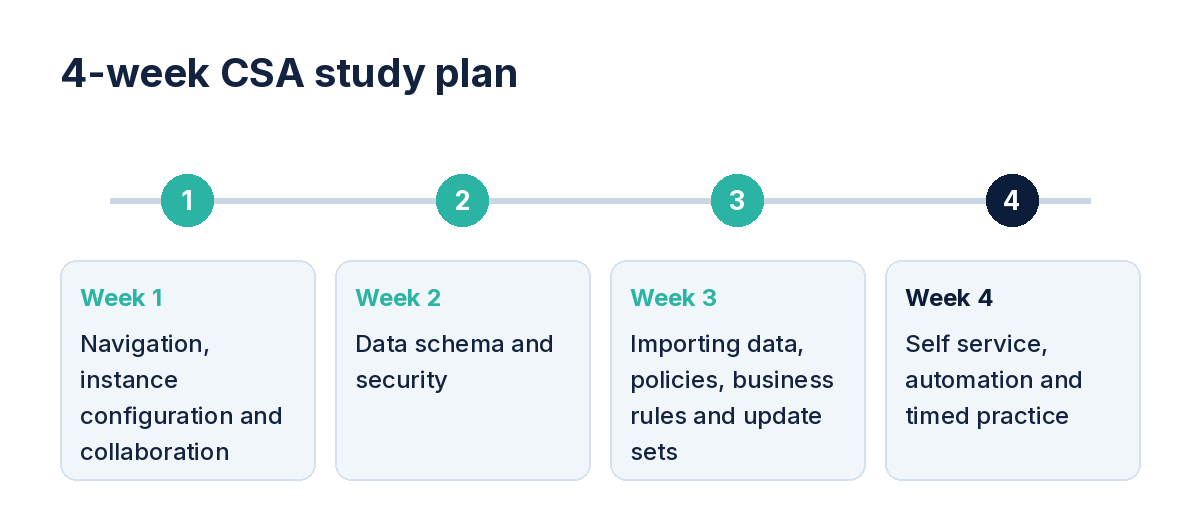
Week 1: Navigation, instance configuration and collaboration
- Use the All menu, Favorites and History until navigation is automatic.
- Personalize a list, then configure the same list for everyone, and compare what changed.
- Configure a form layout, create a form template and build a simple dashboard.
- Create an email notification and test both “When to send” and “Who will receive”.
Week 2: Data schema and security
- Create a table that extends Task and check which fields it inherits.
- Create a table ACL and a field ACL, then impersonate a test user to see the effect.
- Read the Security Center hardening pages and look at the compliance score in your instance.
- Review the CMDB class hierarchy and the basic CSDM ideas.
Week 3: Importing data, policies, business rules and update sets
- Import a spreadsheet through an import set and a transform map. Run it twice, with and without coalesce, and compare the results.
- Build the same rule as a UI policy and as a data policy, then test it from a form and from an import.
- Write one before and one after business rule and watch when each one runs.
- Make changes in an update set, then look at what was captured and what was not.
Week 4: Self service, automation and timed practice
- Create a knowledge article, a catalog item with variables and a simple flow.
- Open Virtual Agent and look at a topic.
- Take at least two timed practice exams of 60 questions in 90 minutes and check every wrong answer against the documentation.
Documentation to bookmark
ServiceNow product documentation for the Zurich release. Australia has equivalent pages; replace zurich with australia in the URL.
Navigation and instance
Collaboration
Data schema and security
- Create a table
- Table extension and classes
- Explore Access Control Lists
- ACL rule types (processing order)
- Configure an ACL rule
- Security Center: security hardening
Importing data
Policies, business rules and update sets
- UI policies
- Data policy
- Data policy fields
- Classic business rules
- Customizations tracking in update sets
Self service and automation
Five sample CSA questions with explanations
I wrote these for this guide. They are not taken from the exam or from any question bank, and each one is based on behavior described in the documentation above.
Question 1 (Database Management and Platform Security, single answer)
An administrator creates an ACL for read on the incident table that requires the itil role and has the data condition Active is true. A user with the itil role opens a closed incident whose Active field is false. No other ACL rules for the incident table grant this user read access. What happens?
- A. The user can read the incident, because having the required role is enough.
- B. The user is denied read access, because a user must pass every condition in a matching ACL rule.
- C. The user can read the incident, but every field appears empty.
- D. The user can read the incident, because data conditions only apply to write operations.
Answer: B. To pass an ACL rule, the user must meet all of its conditions: the required role, the data condition and any script. Failing one condition fails the rule. The system then checks the next matching rule, and if none passes, access is denied. A is the most common misconception. C mixes this up with field-level ACLs. D is wrong because the data condition applies to the operation the ACL secures, which here is read.
Question 2 (Data Migration and Integration, single answer)
While working in an update set on the development instance, an administrator creates a business rule, creates a catalog item with three variables, creates a new assignment group with two members, and places two test orders for the catalog item. Which of these changes are captured in the update set by default?
- A. All of them, because everything done while the update set is current is captured.
- B. The business rule and the catalog item with its variables.
- C. The business rule, the catalog item and the test orders, but not the group.
- D. Only the business rule, because catalog items must be moved with import sets.
Answer: B. Update sets capture configuration, such as business rules and catalog item definitions with their variables. They do not capture task or process data: the documentation uses test catalog orders as its example of what is not tracked. Groups and their members are data, not configuration, so they need to be moved another way, for example with an import or by recreating them. A is the assumption that causes the most surprises after a commit.
Question 3 (Data Migration and Integration, single answer)
An external monitoring tool updates problem records through an import set. The process owner requires Close notes to be filled in before a problem is closed, whether the update comes from a form or from the integration. What should the administrator configure?
- A. A UI policy on the problem form that makes Close notes mandatory when the state is Closed.
- B. A data policy on the problem table that makes Close notes mandatory when the state is Closed, with Apply to import sets selected.
- C. An onSubmit client script that blocks closure when Close notes is empty.
- D. A write ACL on the Close notes field.
Answer: B. UI policies and client scripts run in the browser, so they don’t apply to records updated through an import set. A data policy applies to data entering the system, including import sets when Apply to import sets is selected, and it is also enforced when a record is submitted from the UI. D controls who may write the field, not whether it must be filled.
Question 4 (Database Management and Platform Security, single answer)
An HR team sends a weekly spreadsheet of employees that the administrator loads into the User table through an import set. After the second load, every employee appears twice. Each row has an Employee ID that is unique and mapped to a field on the User table. What change fixes this for future loads?
- A. Select Coalesce on the field map for Employee ID in the transform map.
- B. Delete the import set table before each load.
- C. Run the transform map twice so the second run updates the first.
- D. Add a before business rule on the User table that cancels every insert.
Answer: A. With Coalesce selected on a field map, the transform looks for a target record with the same value. If it finds one, it updates that record; if it doesn’t, it inserts a new one. The field should hold unique values. B and C don’t change how rows are matched to existing users. D would stop new employees from ever being created.
Question 5 (Database Management and Platform Security, choose two)
An administrator creates a new Facilities Request table that extends the Task table. Which two statements are accurate?
- A. The new table inherits the fields defined on Task, such as Number, State and Assignment group.
- B. If no table ACL rule exists for the new table’s own name, table ACL rules defined for Task can apply to it.
- C. Fields created on the new table are added automatically to Task and to every other table that extends Task.
- D. Extending Task copies the existing Task records into the new table.
- E. A table that extends Task cannot have fields of its own.
Answer: A and B. A child table inherits the parent’s fields and can add its own. Table ACL rules are matched by table name first, then by the parent table name, then by the * wildcard, so a Task rule can apply when the child table has no rule of its own. C reverses the direction of inheritance. D is wrong because extending a table shares its structure, not its records. E is wrong because child tables regularly add their own fields.
Where to go after CSA
If you work in IT service management, the next step is CIS-Data Foundations (CMDB and CSDM). ServiceNow requires it before CIS-ITSM. I also have practice tests for it: ServiceNow CIS-DF Practice Tests 2026 | Zurich & Australia on Udemy.
ServiceNow CSA exam FAQ
How many questions are on the ServiceNow CSA exam?
60 questions in 90 minutes. Multiple select questions tell you how many options to choose, and there is no partial credit.
Should CSA be my first ServiceNow certification?
For most people, yes. Every later exam in this series assumes the platform basics CSA covers: tables, access control, data import and update sets.
Which CSA domain carries the most weight?
Database Management and Platform Security, at 30% of the January 2026 blueprint. Data schema, access control and importing data deserve the most study time.
What is the passing score for the CSA exam?
ServiceNow does not publish it. Prepare against the blueprint objectives and use timed practice to find your weak topics.
Are the sample questions in this guide from the real exam?
No. I wrote them for this guide from behavior described in the product documentation. They are practice for reading scenario questions, not a preview of exam content.
Practice tests for the CSA exam
I built a set of practice tests for this exam on Udemy: ServiceNow CSA Practice Tests 2026 | Zurich & Australia. It is the entry point of my practice test series, followed by CIS-Data Foundations, CIS-ITSM, CAD and CIS-CSM.
- 6 practice tests of 60 questions each (360 questions), 90 minutes per test, in English, the same length as the exam format described for the current blueprint
- Questions follow the January 2026 blueprint weights
- Every answer was checked against the Zurich and Australia documentation
- Every option has an explanation, and every question links to the supporting documentation
- All questions are original
Take the CSA practice tests on Udemy
Disclaimer: This is independent study material. It is not affiliated with, sponsored by or endorsed by ServiceNow, Inc. ServiceNow and the ServiceNow product names mentioned here are trademarks of ServiceNow, Inc. Exam details can change; always confirm the current blueprint and requirements on ServiceNow University before booking. The sample questions are original and are not taken from the certification exam.
0 Comments