

Practice tests for this exam: ServiceNow CAD Practice Tests 2026 | Zurich & Australia on Udemy. 6 timed tests of 60 questions, with every option explained and a documentation link for each question.
The ServiceNow CAD exam (Certified Application Developer) has 60 questions in 90 minutes, and 80% of its weight is split equally across four domains: application design, user interface, security and automation. The blueprint lists no certification prerequisite, but it recommends six months of hands-on development and assumes everything CSA covers. Below are the exam facts, the January 2026 domain weights, a 4-week study plan, the documentation to bookmark and five original sample questions with explanations.
The Certified Application Developer (CAD) exam is about building things on ServiceNow the way the platform expects: in a scoped application, with a clean data model, the right mix of client and server logic, access controls that hold up, and automation that someone else can maintain after you leave the project. In my governance work, most of the expensive cleanup I have seen came from apps built without those habits. That is why I care about what CAD tests.
Key facts
- Format: 60 questions in 90 minutes. Multiple choice and multiple select, with no partial credit on multiple select.
- Blueprint: KB0011498, updated January 2026. Four domains at 20% each and two at 10%.
- Prerequisite: no certification listed. Six months of hands-on application development recommended.
- Delivery: Pearson VUE, at a test center or online (OnVUE). You register through ServiceNow University and have 90 days to complete the exam.
- Passing score: not published by ServiceNow.
Before you start: CAD and CSA
ServiceNow’s CAD blueprint does not list a certification prerequisite. What it lists is recommended experience (six months of hands-on application development on ServiceNow) and three recommended courses: Welcome to ServiceNow, Scripting in ServiceNow Fundamentals and Application Development Fundamentals.
That said, CAD assumes everything CSA covers: tables, access control, update sets, UI policies, business rules. If those still feel shaky, I would do CSA first. My guide is here: How to Pass the ServiceNow CSA Exam in 2026.
CAD exam format and facts
| Item | Detail |
|---|---|
| Exam | Certified Application Developer (CAD), mainline exam |
| Blueprint | KB0011498, updated January 2026 |
| Number of questions | 60 |
| Duration | 90 minutes |
| Question types | Multiple choice (at least three options, one answer) and multiple select (at least four options; the question says how many to choose) |
| Partial credit | Not given on multiple select questions |
| Passing score | Not published; ServiceNow says it is not always 70% |
| Delivery | Pearson VUE, at a test center or online (OnVUE), registered through ServiceNow University |
| Scheduling window | 90 days from registration to complete the exam |
| Certification prerequisite | None listed in the blueprint |
Confirm the details in the current blueprint before you book.
ServiceNow CAD exam blueprint: January 2026 weights
| Domain | Weight |
|---|---|
| Designing and Creating an Application | 20% |
| Application User Interface | 20% |
| Security and Restricting Access | 20% |
| Application Automation | 20% |
| Working with External Data | 10% |
| Managing Applications | 10% |
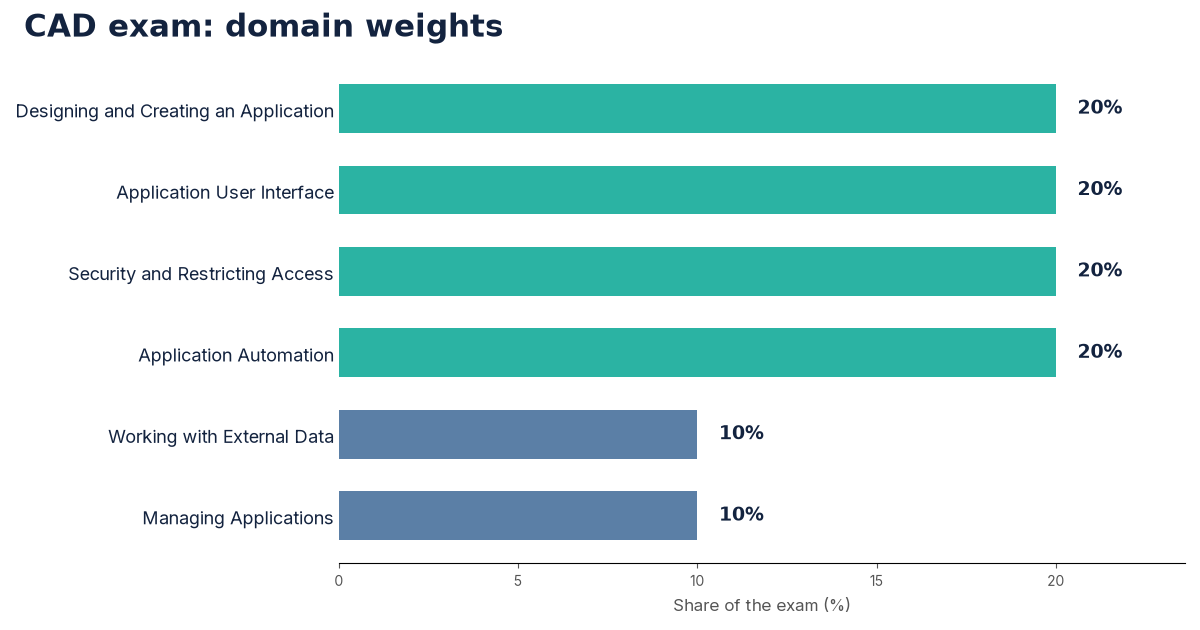
Source: Certified Application Developer (CAD) Exam Blueprint, KB0011498 (ServiceNow University).
Four domains carry 80% of the exam with equal weight, so there is no single domain you can skip. The two 10% domains (external data and managing applications) are the ones people tend to underprepare, and you can cover both in a week.
What each CAD domain asks for
Designing and Creating an Application (20%)
- Deciding whether an application is a good fit for ServiceNow.
- Designing the data model: tables, fields, extending tables and relationships.
- Creating modules and working inside an application scope. Scoped artifacts carry a namespace prefix such as
x_<company code>_<app id>.
Application User Interface (20%)
- Creating and customizing forms, and adding or removing fields.
- Client scripts (onLoad, onChange, onSubmit) and when logic belongs on the server instead.
- Server-side scripts and debugging them.
- Using a record producer as the user interface for an application.
Security and Restricting Access (20%)
- Restricting access to applications and modules with roles.
- Creating, testing and debugging access controls, manually and automatically.
- GlideSystem methods for scripted security, such as checking roles in a script.
- Application scope as a protection layer: the Application Access settings on a table (Accessible from, Can read, Can create, Can update, Can delete) decide what other scopes may do at runtime.
Application Automation (20%)
- Flows in Workflow Studio (Flow Designer) and legacy workflows.
- Application properties for values you should not hard-code.
- Events, scheduled script executions and utility script includes.
- Sending and receiving email.
Working with External Data (10%)
- Importing CSV or Excel data.
- Integrating with an external source over REST: outbound REST messages for calls you make, scripted REST APIs for calls others make to you, and how to test and debug both.
Managing Applications (10%)
- Downloading and installing applications.
- Delegated development: giving non-admin developers specific permissions on one scoped app.
- Source control with the Git integration.
A 4-week study plan for the CAD exam
About 6 to 8 hours a week, all hands-on in a free Personal Developer Instance. Build one small app across the four weeks (for example, a facilities request app) instead of many disconnected exercises.
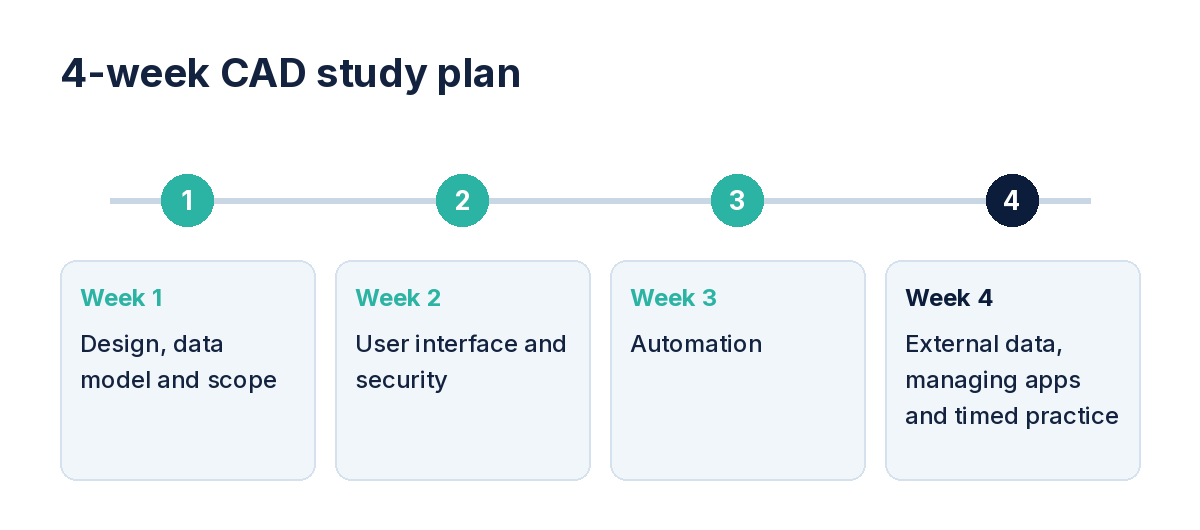
Week 1: Design, data model and scope
- Create a scoped application and look at its namespace prefix.
- Create two tables, one extending Task, with a reference between them, and add modules.
- Open each table’s Application Access settings and note the defaults.
Week 2: User interface and security
- Write an onChange and an onSubmit client script, then move one rule to the server with a client-callable script include and GlideAjax.
- Build a record producer for your app.
- Create roles, restrict a module, and write table and field ACLs. Test them by impersonating users.
Week 3: Automation
- Build a flow triggered by a record update that sends an approval and an email.
- Add an application property and read it from a script.
- Register an event, fire it from a business rule with
gs.eventQueue(), and respond to it with a notification and a script action. - Create a scheduled script execution.
Week 4: External data, managing apps and timed practice
- Import a CSV into your app table.
- Create an outbound REST message to a public test API, test it from the HTTP method, then call it with
sn_ws.RESTMessageV2. - Create a simple scripted REST API and call it from the REST API Explorer.
- Delegate development on your app to a test user with limited permissions, and read how to link an app to source control.
- Take at least two timed practice exams of 60 questions in 90 minutes and check every wrong answer against the documentation.
Documentation to bookmark
ServiceNow product documentation for the Zurich release. Australia has equivalent pages; replace zurich with australia in the URL.
Design and scope
- Plan before you build
- Application scope
- Namespace identifier
- Create a table (including Application Access settings)
- Default runtime access permissions
User interface and scripting
Security
Automation
External data
- Outbound REST web service
- Test a REST method
- RESTMessageV2 API
- Create a scripted REST API resource
- Create a transform map
Managing applications
Five sample CAD questions with explanations
I wrote these for this guide. They are not taken from the exam or from any question bank, and each one is based on behavior described in the documentation above.
Question 1 (Security and Restricting Access, single answer)
A developer builds a Facilities app in its own scope with a table for facility requests, keeping the default Application Access settings. A second scoped app, Visitor Management, needs a server script that creates facility request records. When the script runs, the insert fails. What is the most likely fix?
- A. In the facility request table’s Application Access settings, select Can create, which requires Can read to stay selected.
- B. Change Accessible from to This application scope only.
- C. Add the admin role to the Visitor Management application.
- D. Mark the Visitor Management script include as Client callable.
Answer: A. New application tables allow other scopes to read by default, but Can create, Can update and Can delete are disabled. Can create is only available while Can read is selected. B would block other scopes entirely. C does not change cross-scope runtime permissions. D controls whether client scripts can call a script include through GlideAjax, which has nothing to do with this server-side insert.
Question 2 (Application User Interface, choose two)
On a request form, an onChange client script must check whether the selected user already has open requests. That check needs a server-side query. The developer creates a script include and calls it with GlideAjax. Which two statements are correct?
- A. The script include must be marked Client callable (Glide AJAX enabled), extend AbstractAjaxProcessor, and have a Name that matches its class name.
- B. The client script should pass the method name in the sysparm_name parameter and use getXML() with a callback so the form does not freeze while waiting.
- C. Functions whose names start with an underscore are the ones intended to be called from the client.
- D. getXMLWait() is preferred in onChange scripts because it never blocks the browser.
- E. A display business rule is the only supported way to run server code from a client script.
Answer: A and B. GlideAjax needs a client-callable script include that extends AbstractAjaxProcessor, and its Name must match the class name. The client passes the function to run in sysparm_name and should use getXML() with a callback to avoid blocking the user. C is reversed: functions starting with “_” are treated as private and are not callable from the client. D is wrong because getXMLWait() blocks the client. E is wrong because GlideAjax is exactly the supported way to run server code from the client on demand.
Question 3 (Application Automation, single answer)
A business rule in the Facilities app calls gs.eventQueue('x_acme_fac.request.approved', current, gs.getUserID(), gs.getUserName()) when a request is approved. The developer wants an email notification to be sent when this event fires, but the event name does not appear in the notification’s event list. What is missing?
- A. The event has not been registered in the Event Registry.
- B. The business rule must run async for events to be visible to notifications.
- C. Notifications can only respond to events whose names start with
sys.. - D. The event must be fired from a client script instead of a business rule.
Answer: A. Events have to be registered in the Event Registry before notifications and script actions can respond to them. Once registered, the event appears in the notification’s “Event is fired” setting and can be used by a script action. B, C and D describe restrictions that don’t exist; gs.eventQueue() is a server-side call made from scripts such as business rules.
Question 4 (Working with External Data, single answer)
The Facilities app needs to fetch delivery status from a carrier’s REST API whenever a request is updated. The developer wants to define the endpoint, authentication and HTTP method once, test the call before writing any script, and then reuse it from server-side code. What should the developer create?
- A. An outbound REST message with an HTTP method, tested from the HTTP method record, and called in script with
sn_ws.RESTMessageV2. - B. A scripted REST API with a GET resource.
- C. An import set with a transform map pointing to the carrier’s URL.
- D. A client script that calls the carrier’s API directly from the browser.
Answer: A. An outbound REST message stores the endpoint and HTTP methods, lets you test a method and see the status and response, and can be invoked from scripts with RESTMessageV2. B is the opposite direction: a scripted REST API is an endpoint on your instance that external systems call. C is for loading data into tables, not making a call during a record update. D would expose the integration to the browser and skip server-side control.
Question 5 (Managing Applications, choose two)
A team lead wants two non-admin developers to work on the scoped Facilities app. They should be able to edit tables, forms and scripts in that app only, without being able to change access controls or roles. Which two statements are accurate?
- A. Developer permissions through delegated development are available only for scoped applications.
- B. An admin can open the application record, select Manage Developers, add the users, and grant permissions such as Tables & Forms and Enable Scripting without granting Manage ACLs & Roles.
- C. Delegated developers receive the admin role on the instance for the duration of their assignment.
- D. The Delegated Admin permission grants read-only access to the application.
- E. Delegated development applies to all applications on the instance once enabled for a user.
Answer: A and B. Delegated development lets an admin (or application administrator, when that is enabled) assign developers to one specific scoped app and choose individual permissions, such as Tables & Forms, Enable Scripting and Manage ACLs & Roles. Developer permissions are not available for global apps. C is wrong because the point is to let people build without the admin role. D is wrong because Delegated Admin grants all delegated development permissions at once. E is wrong because permissions are assigned per application.
Where CAD fits in the path
For most developers the order is CSA, then CAD. If your work also touches ITSM implementation, the CIS track (CIS-Data Foundations, then CIS-ITSM) runs alongside it.
The full order, with all five exams, is in my ServiceNow certification path for 2026.
ServiceNow CAD exam FAQ
How many questions are on the ServiceNow CAD exam?
60 questions in 90 minutes. Multiple choice questions have one correct answer. Multiple select questions tell you how many options to choose, and there is no partial credit.
Do I need the CSA certification before the CAD exam?
No. The CAD blueprint lists no certification prerequisite. It recommends six months of hands-on application development, and the questions assume everything CSA covers, so many people take CSA first.
What is the passing score for the CAD exam?
ServiceNow does not publish it and says it is not always 70%. Prepare against the blueprint objectives instead of a target percentage.
Can I take the CAD exam online?
Yes. Pearson VUE delivers it at a test center or online through OnVUE. You register through ServiceNow University and have 90 days from registration to complete the exam.
Are the sample questions in this guide from the real exam?
No. I wrote them for this guide from behavior described in the product documentation. They are practice for reading scenario questions, not a preview of exam content.
Practice tests for the CAD exam
I built a set of practice tests for this exam on Udemy: ServiceNow CAD Practice Tests 2026 | Zurich & Australia.
- 6 practice tests of 60 questions each (360 questions), 90 minutes per test, in English, the same length as the exam described in the current blueprint
- Questions follow the January 2026 blueprint weights
- Every answer was checked against the Zurich and Australia documentation
- Every option has an explanation, and every question links to the supporting documentation
- All questions are original
Take the CAD practice tests on Udemy
Disclaimer: This is independent study material. It is not affiliated with, sponsored by or endorsed by ServiceNow, Inc. ServiceNow and the ServiceNow product names mentioned here are trademarks of ServiceNow, Inc. Exam details can change; always confirm the current blueprint and requirements on ServiceNow University before booking. The sample questions are original and are not taken from the certification exam.

0 Comments